
Headlines


Contact us
Address:MegaRock Railway Equipment Co.,Ltd.
JinYouLi Creative Park,
JianShe NanLu #81,
ChengHua District,
Chengdu City,
Sichuan
Province,
610051,
PR China
Email:info@megarockgroup.com
Tel:+86 (028) 6250 8785
Headlines > News
Careful Protection on Railway Lines
Source: Xinhua News Agency |
January 9, 2026
Hefei, January 9 — (Xinhua News Agency, reporter Pan Feng) As trains laden with passengers
rush forward, few notice that along thousands of kilometers of railway lines, there is
always a contingent of police standing watch in relay. As the sixth Chinese People's Police
Day approaches, this reporter traveled northward from Hefei along the railway, seeking out a
group of people who work with the railways year-round—they are railway police, the unsung
"railway spikes" ensuring safe rail travel.
The sky grows dim; Daiji Station, a fourth-class small station on the outskirts of Hefei, sits silent, with rails extending into the distance. In the darkness, a flashlight beam suddenly cuts through. The beam sweeps along the railway line, rising and falling, illuminating sleepers, protective netting, and railway communication equipment.
Wang Zhiqiang, deputy director of the Shuijahu Station Police Substation under the Shanghai Railway Public Security Bureau's Bengbu Public Security Office, is conducting a patrol. "In winter, we must pay special attention to plastic sheeting from greenhouses along the line, preventing strong winds from blowing these lightweight materials onto the rails; near farmland, we watch for agricultural drones at work," he explains to his young colleague while patrolling, sharing essential points.
After 14 years of youth spent repeatedly traversing the rails, Wang Zhiqiang knows his jurisdiction intimately. He can readily recite how many level crossings and culverts exist on his route, which villages it passes through, and what potential risks each critical section may pose. In the past six months alone, he has inspected and identified over 20 seasonal safety hazards and coordinated with relevant departments to eliminate more than 10 external environmental problems, including lightweight debris, making train operations safer.
When Wang Zhiqiang first arrived at Shuijahu Station Substation, his jurisdiction contained only 3 regular-speed rail lines; today it encompasses 5 regular-speed lines and 3 high-speed rail lines, expanding from over 90 kilometers to 250 kilometers. "The burden on my shoulders feels heavier," Wang Zhiqiang says. To weave a comprehensive safety net, officers at the substation carry backpacks during patrols filled with public safety education pamphlets and police-community contact cards, conducting outreach wherever they go.
As Wang Zhiqiang's flashlight beam fades from sight, another beacon of protection shines in the flowing cars of the G1602 high-speed train. Li Binbin, a post-2000s-generation railway security officer, stands at the junction between cars, preparing for another security inspection. This somewhat shy young officer, having worn the uniform for less than two years, already works independently and confidently.
"My 'office' has wheels, and in a day I can traverse half of China," Li Binbin says with a smile. "The train car is a flow of human warmth and daily life; my job is to protect this hot and steaming peace." He then returns to his duties—checking whether luggage on racks is properly secured, ensuring fire safety equipment functions correctly, and monitoring passenger wellbeing, all within his vigilant eyes.
Since joining the force, Li Binbin has grown remarkably well. He has deliberately studied communication skills, filling his notebook with conflict resolution methods from veteran officers, making dispute resolution second nature. To protect passengers' financial security, he has summarized common telecommunications fraud methods for public education. "Rails are cold, but protection must have warmth," Li Binbin says.
The train glides smoothly into Fuyang West Station, yet Li Binbin's pace doesn't slow. In the station, Ruan Shengkun, an officer at the Fuyang West Station Police Substation under the Shanghai Railway Public Security Bureau's Bengbu Public Security Office, moves through the crowd, continuing the relay to protect passengers' final stretch.
Moving among the crowds at 55, Ruan Shengkun's gaze remains sharp. Those eyes, jokingly called "scanners" by colleagues, have locked onto theft suspects in crowded waiting halls of over a thousand people. When recalling a night when he pursued a theft suspect continuously, Ruan Shengkun's eyes brighten—that intensity is his instinctive commitment to station safety.
"In recent years, criminal cases in the station have dropped dramatically, easing the pressure on our patrols considerably," Ruan Shengkun says. Now, his keen observation is increasingly directed toward serving the public: when passengers can't find the entrance, struggle with their luggage, or show a glimpse of confusion in their eyes, he often approaches proactively before they can speak.
As the deep winter cold intensifies and the Spring Festival travel rush approaches, at 8:30 the following morning, Ruan Shengkun finishes a night of duty and immediately returns to the substation to discuss Spring Festival security plans with colleagues, busy with preparations. He tells this reporter that his child works in Shanghai and will return home for the New Year this year. "Someone must journey to a distant home, so someone else must protect the way home."
South-bound and north-bound trains flow ceaselessly. Within and between the cars, stories of people rushing toward reunion, interwoven with the unflinching vigil of these guardians, compose a moving portrait of flowing China.
The sky grows dim; Daiji Station, a fourth-class small station on the outskirts of Hefei, sits silent, with rails extending into the distance. In the darkness, a flashlight beam suddenly cuts through. The beam sweeps along the railway line, rising and falling, illuminating sleepers, protective netting, and railway communication equipment.
Wang Zhiqiang, deputy director of the Shuijahu Station Police Substation under the Shanghai Railway Public Security Bureau's Bengbu Public Security Office, is conducting a patrol. "In winter, we must pay special attention to plastic sheeting from greenhouses along the line, preventing strong winds from blowing these lightweight materials onto the rails; near farmland, we watch for agricultural drones at work," he explains to his young colleague while patrolling, sharing essential points.
After 14 years of youth spent repeatedly traversing the rails, Wang Zhiqiang knows his jurisdiction intimately. He can readily recite how many level crossings and culverts exist on his route, which villages it passes through, and what potential risks each critical section may pose. In the past six months alone, he has inspected and identified over 20 seasonal safety hazards and coordinated with relevant departments to eliminate more than 10 external environmental problems, including lightweight debris, making train operations safer.
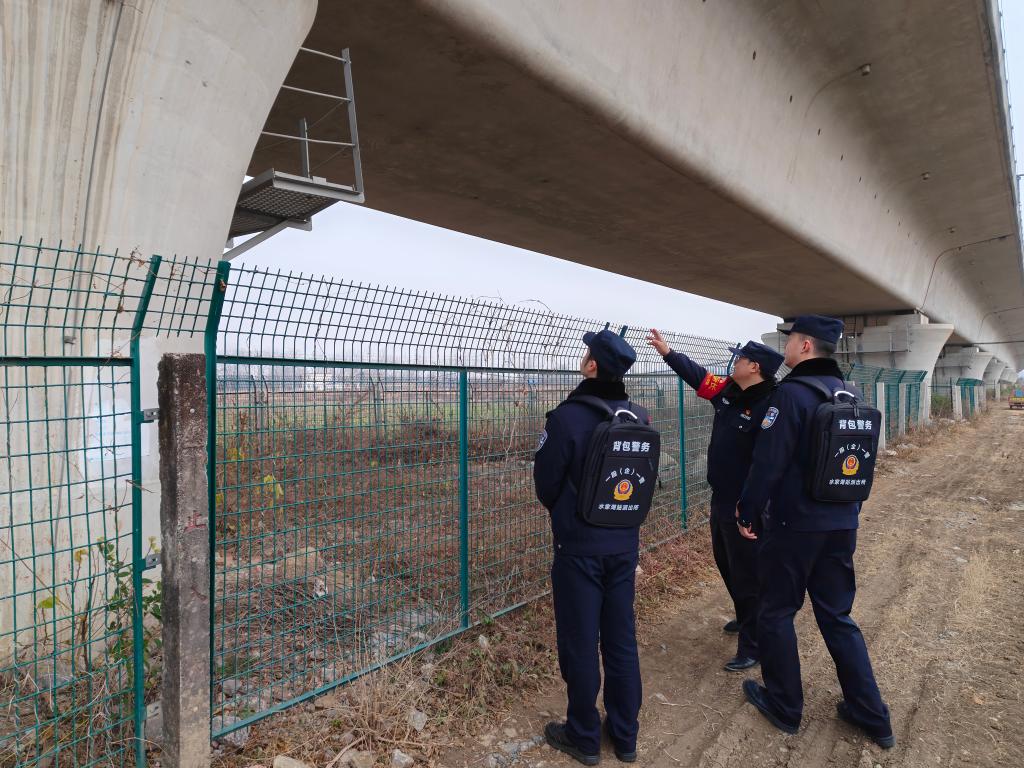
Wang Zhiqiang and colleagues conduct patrol on high-speed rail
line. (Xinhua News Agency, photographer Pan Feng)
When Wang Zhiqiang first arrived at Shuijahu Station Substation, his jurisdiction contained only 3 regular-speed rail lines; today it encompasses 5 regular-speed lines and 3 high-speed rail lines, expanding from over 90 kilometers to 250 kilometers. "The burden on my shoulders feels heavier," Wang Zhiqiang says. To weave a comprehensive safety net, officers at the substation carry backpacks during patrols filled with public safety education pamphlets and police-community contact cards, conducting outreach wherever they go.
As Wang Zhiqiang's flashlight beam fades from sight, another beacon of protection shines in the flowing cars of the G1602 high-speed train. Li Binbin, a post-2000s-generation railway security officer, stands at the junction between cars, preparing for another security inspection. This somewhat shy young officer, having worn the uniform for less than two years, already works independently and confidently.
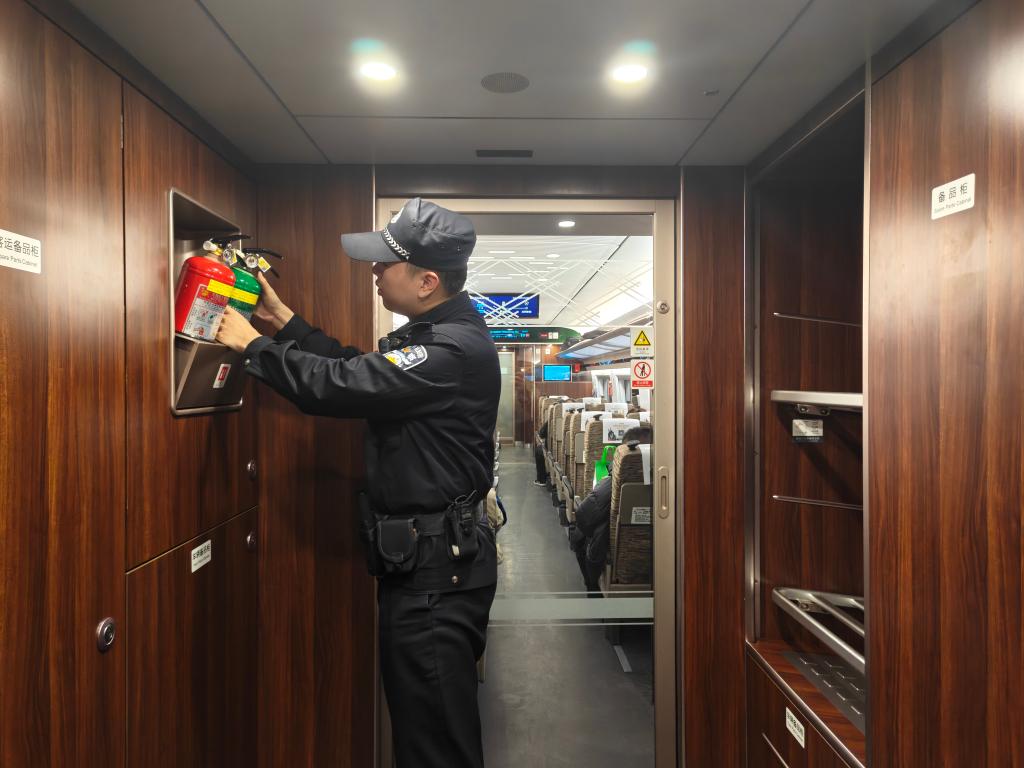
"My 'office' has wheels, and in a day I can traverse half of China," Li Binbin says with a smile. "The train car is a flow of human warmth and daily life; my job is to protect this hot and steaming peace." He then returns to his duties—checking whether luggage on racks is properly secured, ensuring fire safety equipment functions correctly, and monitoring passenger wellbeing, all within his vigilant eyes.
Li Binbin checks fire safety equipment in the cabin. (Xinhua
News Agency, photographer Pan Feng)
Since joining the force, Li Binbin has grown remarkably well. He has deliberately studied communication skills, filling his notebook with conflict resolution methods from veteran officers, making dispute resolution second nature. To protect passengers' financial security, he has summarized common telecommunications fraud methods for public education. "Rails are cold, but protection must have warmth," Li Binbin says.
The train glides smoothly into Fuyang West Station, yet Li Binbin's pace doesn't slow. In the station, Ruan Shengkun, an officer at the Fuyang West Station Police Substation under the Shanghai Railway Public Security Bureau's Bengbu Public Security Office, moves through the crowd, continuing the relay to protect passengers' final stretch.
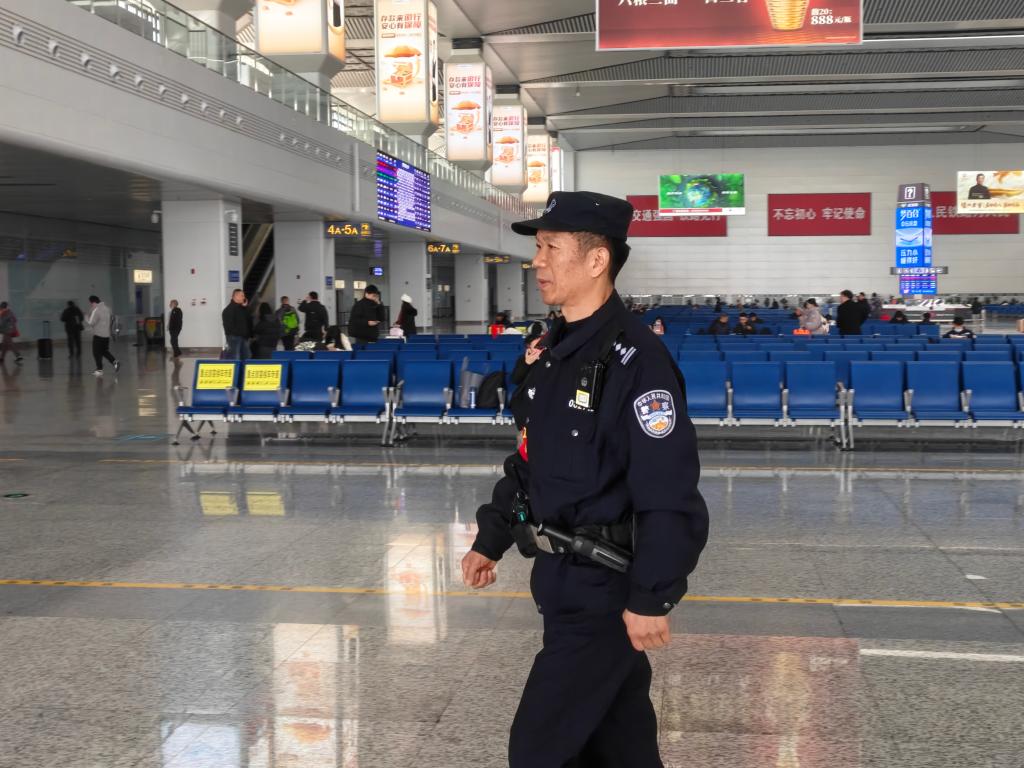
Moving among the crowds at 55, Ruan Shengkun's gaze remains sharp. Those eyes, jokingly called "scanners" by colleagues, have locked onto theft suspects in crowded waiting halls of over a thousand people. When recalling a night when he pursued a theft suspect continuously, Ruan Shengkun's eyes brighten—that intensity is his instinctive commitment to station safety.
"In recent years, criminal cases in the station have dropped dramatically, easing the pressure on our patrols considerably," Ruan Shengkun says. Now, his keen observation is increasingly directed toward serving the public: when passengers can't find the entrance, struggle with their luggage, or show a glimpse of confusion in their eyes, he often approaches proactively before they can speak.
Ruan Shengkun stands guard at Fuyang West Station. (Xinhua News
Agency, photographer Pan Feng)
As the deep winter cold intensifies and the Spring Festival travel rush approaches, at 8:30 the following morning, Ruan Shengkun finishes a night of duty and immediately returns to the substation to discuss Spring Festival security plans with colleagues, busy with preparations. He tells this reporter that his child works in Shanghai and will return home for the New Year this year. "Someone must journey to a distant home, so someone else must protect the way home."
South-bound and north-bound trains flow ceaselessly. Within and between the cars, stories of people rushing toward reunion, interwoven with the unflinching vigil of these guardians, compose a moving portrait of flowing China.

Copyright ©2018 MegaRock all rights reserved Sichuan ICP license 2020030856号 Website support:info@megarockgroup.com