
Headlines


Contact us
Address:MegaRock Railway Equipment Co.,Ltd.
JinYouLi Creative Park,
JianShe NanLu #81,
ChengHua District,
Chengdu City,
Sichuan
Province,
610051,
PR China
Email:info@megarockgroup.com
Tel:+86 (028) 6250 8785
Headlines > News
Building Pathways on the Loess Plateau—Written on the Day of Yan'an's First
High-Speed Rail Opening
Source: Xinhua News Agency |
December 26, 2025
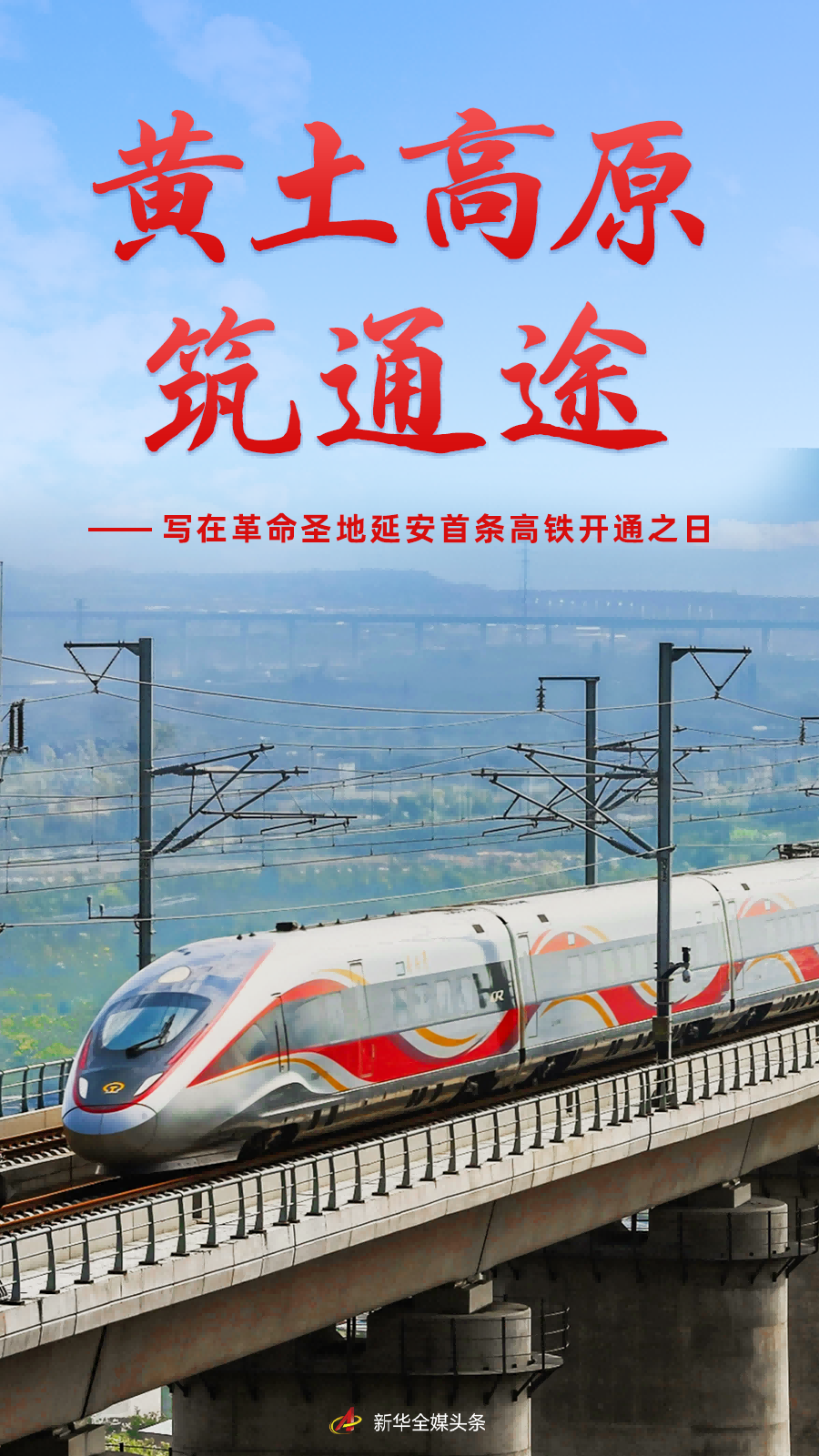
Traversing ravines and peaks, glimpsing historic landmarks along the way. Laden with the aspirations of revolutionary-era communities, the high-speed rail has finally reached beneath Pagoda Mountain.
On December 26, the Xi'an-Yan'an High-Speed Railway officially commenced operations, welcoming the revolutionary holy land of Yan'an into China's national high-speed rail network. Reaching Xi'an in approximately one hour, Yan'an's connections with the Guanzhong Plain urban cluster and broader regions have intensified, accelerating old-region revitalization.
This railway witnessed ardent concern—In February 2015, Xi Jinping, General Secretary of the Party Central Committee, convened the poverty alleviation and prosperity meeting for the Shaanxi-Gansu-Ningxia revolutionary regions in Yan'an, emphasizing: "Substantially increase investment support, accelerate old-region development, ensuring all residents enjoy prosperous lives." Subsequently, design plans accelerated and geological surveys intensified...the Xi'an-Yan'an high-speed rail gradually transformed from planning into reality.
This railway records steadfast efforts—Spanning multiple years of construction, bridge-tunnel ratio reaching 91%, builders overcame collapsible loess soil—a world-class engineering challenge—and constructed an innovative, green, humanistic pathway across the Loess Plateau, China's "natural geological museum."
This railway carries development aspirations—It will reshape Yan'an's economic geography, establishing "golden channels" for bidirectional flow of capital, technology, and talent, infusing vitality into industrial upgrading and high-quality development.
Across the Loess Plateau, extending rails and speeding trains paint a beautiful vision of the revolutionary region racing toward happiness.
From Donkey Transport to Steel Arteries—A High-Speed Rail Behind a Solemn Promise
Winter warmth bathes Yan'an railway station's platform. Around 10 AM on the 26th, the "Fuxing" intelligent EMU departs the platform, racing toward the Guanzhong Plain, materializing the high-speed rail dream lingering in revolutionary-era generations' hearts.
On the platform, northern Shaanxi folk dance teams have begun their rhythmic swaying, red silks flying like flames; within the cabins, robust yet melodious northern Shaanxi folk songs draw continuous applause, vivid paper-cutting decorations adorn windows.
Within the cabin, 64-year-old Yan'an passenger Liu Caixia reflects with deep emotion: "In my parents' youth, departing required 'herding livestock,' enduring jolting donkey transport. Later we took buses and green-painted trains—even reaching Xi'an required half a day. Now boarding high-speed rail, we 'whoosh' to Xi'an instantly—truly unimaginable!"
Watching the train depart, 52-year-old Yan Ze, Party secretary of the Xi-Yan High-Speed Railway project of China Railway 21st Bureau, has eyes glistening with tears: "Throughout our journey, we've encountered countless difficulties. Yet we continually carried Yan'an Spirit—building railways for the revolutionary holy land is both glory and mission. Reaching today's moment, all our suffering was worthwhile!"
Rolling wheels unfold temporal scrolls: high-speed rails connect Pagoda Mountain, Luochuan Conference Site and other historic locations. Traversing ages, successive red landmarks witness revolutionary victory and welcome new-era transformations.
Rolling wheels record transportation evolution: 1991 saw Xi-Yan railway completion; 2006 witnessed Yan-Xi expressway opening; 2018 brought South Nieyuan Airport service, ushering Yan'an into "air-rail coordinated" new phase.
Rolling wheels witness Loess Plateau transformation: once-barren ridges now wear green; currently Yan'an's vegetation coverage exceeds 81%, forming nationally renowned apple production regions. Mountains have greened, holy lands beautified, communities enriched...
Monumental transformations reflect the Party Central Committee's consistent, heartfelt concern for Yan'an.
In February 2015, Xi Jinping, General Secretary, convened the Shaanxi-Gansu-Ningxia revolutionary region poverty alleviation meeting in Yan'an, pondering regional development. In October 2022, General Secretary Xi again reflected deeply upon paying respects to Yan'an revolutionary commemorative sites: "Yan'an and its people made tremendous contributions to China's revolutionary enterprise—we must eternally remember."
Sincere directives transformed into forward momentum. In May 2021, as a crucial component of the nation's "Eight Vertical and Eight Horizontal" high-speed rail network's Baotou-Yinchuan-Haikou corridor, Xi-Yan High-Speed Railway construction commenced.
From eliminating absolute poverty to county-level expressway coverage, contemporary era has brought successive major events to Yan'an. He Lei, professor at China Yan'an Cadre Academy, stated that Yan'an's high-speed rail opening represents another hallmark event for revolutionary regions advancing Chinese-style modernization—testimony to Chinese Communist Party members' original aspirations and missions.
Innovation, Green, Humanistic Pathway—Constructing Thoroughfares Across the Loess Plateau
"This soil resembles modeling clay—soft and plastic, yet prone to sudden collapse when encountering water. Frankly, we're 'sculpting within quicksand,'" reflected Jiang Han, project director of China Railway 20th Bureau's Xi-Yan High-Speed Railway, recalling the 4-kilometer tunnel construction in Luochuan County.
To overcome challenges, builders excavated merely half-meter segments, then rapidly constructed steel "protective shells" using concrete, while implementing pre-grouting to "strengthen and reinforce" loose soil matrices. Through employing segmented excavation and intelligent monitoring—refined craftsmanship—builders ultimately forged solid underground passages within the extremely fragile loess.
The Loess Plateau's ravines and gullies characterize complex geology, earning designation as "natural geological museum." Constructing 350 km/h high-speed rail here surpasses imagination in difficulty.
Liu Wentao, Xi-Yan High-Speed Railway Chief Designer at China Railway First Survey and Design Institute Group, noted the line contains five tunnels exceeding 10 kilometers, the longest Yijun tunnel spanning 17.5 kilometers. The route crosses four geomorphological units—Weihe alluvial plains, loess plateaus, Ziwu Mountains' low-mid ranges, and loess gullied terrain—achieving 91% bridge-tunnel ratio while overcoming collapsible loess, a world-class engineering challenge.
Challenges permeate everywhere: Yijun Tunnel's maximum burial depth reaches 395 meters, requiring construction amidst poor geological conditions and dense pipelines; Wangjiaohe Special Bridge spans 248 meters between adjacent piers, rising 105 meters high, challenging ballastless track's millimeter-precision deformation control; Liujiaohe-2 Tunnel's exit protective slope rises approximately 30 stories...
"In South Nieyuan years, the 359th Regiment soldiers transformed barren mountains and putrid marshes into northern Shaanxi's beautiful landscape—this spirit continually inspires us," reflected Ren Liutao, Project Manager of China Railway 11th Bureau's Xi-Yan High-Speed Railway 14th section, whose team principally handled rail-laying while facing large-span conversion challenges crossing Xi-Xian expressway. Employing innovative techniques, they completed construction while maximizing pier-top conversion safety, efficiency, and economy.
This steel giant pursues velocity while striving for ecological harmony and coexistence.
Cloud spruce, roses, Amur maple...Wu Jiancai, Party Vice-Secretary of China Railway 21st Bureau's Xi-Yan High-Speed Railway project, maintains a special "seedling archive" on his phone: "Throughout construction, we implemented harmless disposal of waste rock and soil, transforming them into subgrade substrate or reclaimed field matrix, planting seedlings and crops—restoring greenery to revolutionary regions."
Environmental stewardship manifests throughout construction processes. Protecting water sources, Yijun Tunnel's wastewater required transport ten-plus kilometers for treatment. "Ecological accounting cannot be deferred," stated Wang Tianyong, Project Director of China Railway 12th Bureau's Xi-Yan High-Speed Railway section.
Traveling northward aboard Xi-Yan High-Speed Rail, lineside stations ingeniously transform into regional culture display windows: Fuping South Station's clay-brick walls embody "Guanzhong distinguished location" elegance; Tongchuan North Station's geometric roof design echoes mountain contours; Huangling West Station's Han-style architecture honors reverence for humanity's cultural progenitors...

Copyright ©2018 MegaRock all rights reserved Sichuan ICP license 2020030856号 Website support:info@megarockgroup.com