
Headlines


Contact us
Address:MegaRock Railway Equipment Co.,Ltd.
JinYouLi Creative Park,
JianShe NanLu #81,
ChengHua District,
Chengdu City,
Sichuan
Province,
610051,
PR China
Email:info@megarockgroup.com
Tel:+86 (028) 6250 8785
Headlines > News
Shanghai-Chongqing-Chengdu Yangtze River High-Speed Railway Wu-Yi Section
Opens, Further Expands Yangtze River Economic Belt High-Speed Rail Network
Source: Xinhua News Agency |
December 26, 2025
At approximately 9:50 AM on December 26, as G6800 train departed Yichang North Station, the
Wuhan-Yichang section of the Shanghai-Chongqing-Chengdu Yangtze River Corridor High-Speed
Railway officially commenced operations.
This new arterial high-speed rail along China's Yangtze River Economic Belt will substantially facilitate resident travel along the corridor, holding significant importance for rapidly constructing the Yangtze River comprehensive transportation system and advancing high-quality development of the Yangtze River Economic Belt.
The Wuhan-Yichang section, comprehensively surveyed and designed by China Railway Fourth Survey and Design Institute Group, constitutes an important component of China's 'Eight Vertical and Eight Horizontal' high-speed rail network's Yangtze River corridor. Commencing at Hankou Station in Wuhan, traversing Tianmen and Jingmen municipalities, and connecting Yichang North Station in Yichang, the 314-kilometer line operates at 350 km/h design speed.
The entire Wuhan-Yichang segment crosses the Jianghan Plain while linking the Wuling Mountains, with bridges and tunnels comprising 85% of the route, presenting significant design and construction challenges. To address this, railway authorities organized relevant units to strengthen design innovation and deploy intelligent construction, ensuring operational safety and stability.
Yan Le, track design director at the Fourth Survey and Design Institute, informed reporters that over one million concrete sleepers supporting high-speed train smooth operation were individually fabricated by intelligent robots with millimeter-level precision. Each sleeper possesses unique identification, achieving full-lifecycle intelligent management from production through installation to operational maintenance.
Jin Hanwen, chief engineer of China Railway 11th Bureau, a participating constructor, noted that during main beam construction of the Zhongxiang Hanjiang Railway Grand Bridge—the controlling project across the entire line—the project team validated observed and theoretical deformations for each construction segment, dynamically adjusting parameters to effectively ensure ballastless track installation precision and rail smoothness.
Full-chain craftsmanship preservation has forged quality engineering. Before formal opening of the Shanghai-Chongqing-Chengdu Yangtze River Corridor High-Speed Railway's Wuhan-Yichang section, the CR450 train set, hailed as 'globally fastest high-speed rail,' underwent mainline testing and operational assessment here, achieving records of single-train 453 km/h velocity and relative meeting speed of 896 km/h.
Hubei Province, positioned at China's railway network center and geographical midpoint, with networks traversing north-south and linking east-west, constitutes a nationally critical railway hub. Li Qubo, transport department vice director of State Railway Wuhan Bureau, stated that the Wuhan-Yichang section opening will enable Hubei's major cities to form 1-hour high-speed commuting zones and reach national principal cities within 3-4 hours, potentially substantially enhancing regional personnel mobility efficiency and economic cooperation potential.
This new arterial high-speed rail along China's Yangtze River Economic Belt will substantially facilitate resident travel along the corridor, holding significant importance for rapidly constructing the Yangtze River comprehensive transportation system and advancing high-quality development of the Yangtze River Economic Belt.
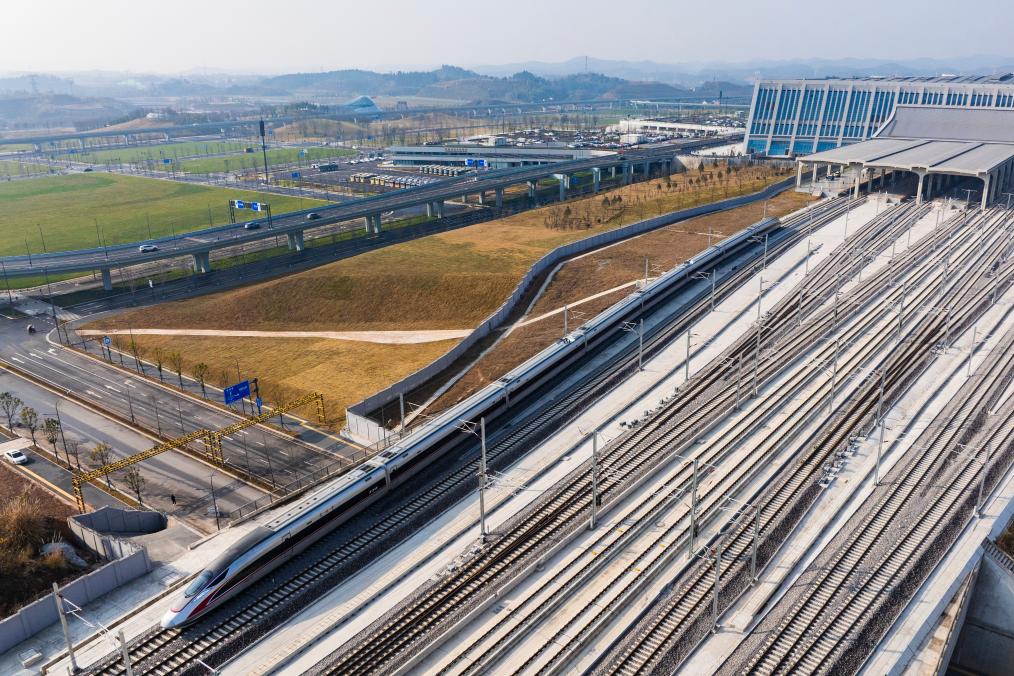
On December 26, the G6800 train departed from Yichang North
Railway Station. Photo by Wu Zhizun, Xinhua News Agency reporter.
The Wuhan-Yichang section, comprehensively surveyed and designed by China Railway Fourth Survey and Design Institute Group, constitutes an important component of China's 'Eight Vertical and Eight Horizontal' high-speed rail network's Yangtze River corridor. Commencing at Hankou Station in Wuhan, traversing Tianmen and Jingmen municipalities, and connecting Yichang North Station in Yichang, the 314-kilometer line operates at 350 km/h design speed.
The entire Wuhan-Yichang segment crosses the Jianghan Plain while linking the Wuling Mountains, with bridges and tunnels comprising 85% of the route, presenting significant design and construction challenges. To address this, railway authorities organized relevant units to strengthen design innovation and deploy intelligent construction, ensuring operational safety and stability.
Yan Le, track design director at the Fourth Survey and Design Institute, informed reporters that over one million concrete sleepers supporting high-speed train smooth operation were individually fabricated by intelligent robots with millimeter-level precision. Each sleeper possesses unique identification, achieving full-lifecycle intelligent management from production through installation to operational maintenance.
Jin Hanwen, chief engineer of China Railway 11th Bureau, a participating constructor, noted that during main beam construction of the Zhongxiang Hanjiang Railway Grand Bridge—the controlling project across the entire line—the project team validated observed and theoretical deformations for each construction segment, dynamically adjusting parameters to effectively ensure ballastless track installation precision and rail smoothness.
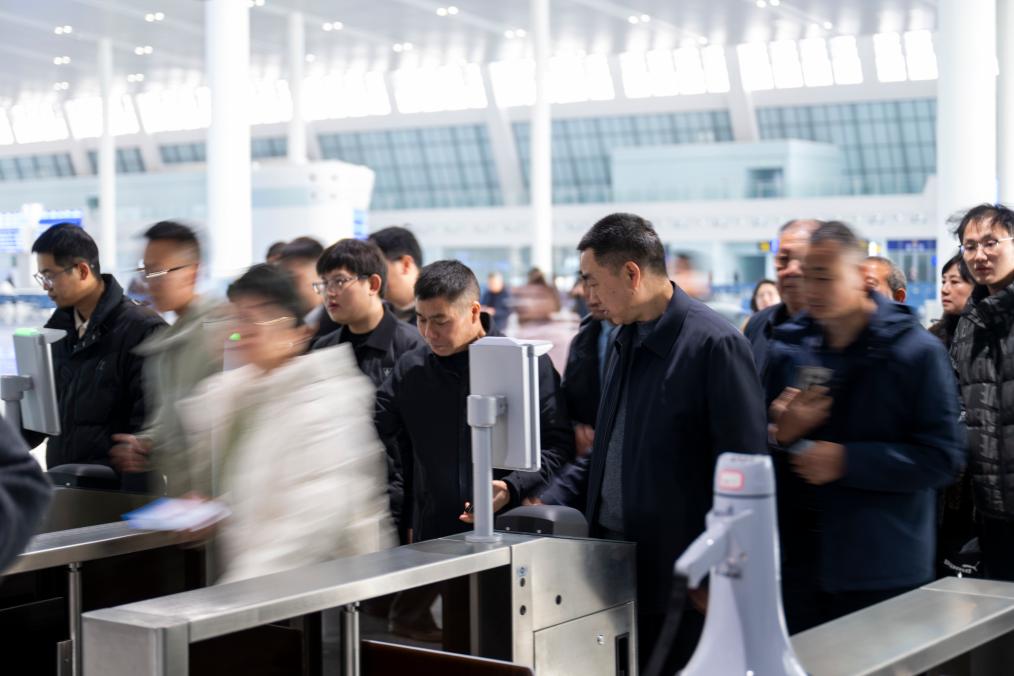
On December 26th, passengers checked in at the waiting hall of
Yichang North Railway Station. Photo by Wu Zhizun, Xinhua News Agency reporter.
Full-chain craftsmanship preservation has forged quality engineering. Before formal opening of the Shanghai-Chongqing-Chengdu Yangtze River Corridor High-Speed Railway's Wuhan-Yichang section, the CR450 train set, hailed as 'globally fastest high-speed rail,' underwent mainline testing and operational assessment here, achieving records of single-train 453 km/h velocity and relative meeting speed of 896 km/h.
Hubei Province, positioned at China's railway network center and geographical midpoint, with networks traversing north-south and linking east-west, constitutes a nationally critical railway hub. Li Qubo, transport department vice director of State Railway Wuhan Bureau, stated that the Wuhan-Yichang section opening will enable Hubei's major cities to form 1-hour high-speed commuting zones and reach national principal cities within 3-4 hours, potentially substantially enhancing regional personnel mobility efficiency and economic cooperation potential.

Copyright ©2018 MegaRock all rights reserved Sichuan ICP license 2020030856号 Website support:info@megarockgroup.com